
February 18, 2026
Garage floors take constant abuse. Hot tires, winter salt, moisture, dropped tools, chemical spills, and temperature swings all hit the concrete day after day. Choosing the right coating matters because once it’s installed, homeowners expect it to last for years, not just look good for a season.
Two options dominate the conversation: epoxy and polyaspartic. Both promise protection and a clean, finished look. Only one consistently holds up long-term, especially in Ohio conditions. This comparison breaks down how each performs and which truly earns the title of best garage floor coating.
Epoxy has been used for decades, and its popularity came from accessibility. It offers a smooth finish, improves appearance, and initially protects the concrete from stains and dust. Many homeowners encounter epoxy first because it’s widely marketed and available in DIY kits.
Epoxy floors can perform adequately in controlled environments such as climate-regulated interiors or light-use spaces. On install day, the floor often looks sharp and polished. That early impression is why epoxy gained traction.
The problem shows up later.
Epoxy cures into a hard, rigid surface. That rigidity becomes a liability when concrete expands and contracts due to temperature changes. Ohio garages see dramatic swings across seasons, and epoxy struggles to flex with the slab.
Common epoxy failures include:
Once epoxy begins to fail, repairs are rarely simple. Peeling spreads, moisture creeps underneath, and the entire system often needs removal before reapplication.
Polyaspartic floor coating systems were developed to solve the weaknesses of epoxy. Instead of curing into a brittle surface, polyaspartic coatings remain flexible while maintaining strength. That flexibility allows the coating to move with the concrete rather than fight against it.
Several factors set polyaspartic apart:
These qualities translate directly into longevity. A floor that bonds deeper, flexes with the slab, and resists environmental damage simply lasts longer.
Longevity comes down to how each material responds to real-world conditions.
Epoxy relies heavily on ideal prep and controlled environments. Even small deviations can shorten its lifespan. Moisture vapor rising through the slab, temperature shifts during curing, or daily vehicle use can all compromise performance.
Polyaspartic systems tolerate a wider range of conditions. Faster cure times reduce exposure to moisture during install. Stronger chemical structure increases resistance to abrasion and impact. UV stability ensures the floor looks the same years later as it did on day one.
Many homeowners choose polyaspartic specifically because it holds up under hot tire pressure, which is one of epoxy’s biggest weaknesses.
Epoxy installations often require multiple days. Each layer needs extended curing time, and foot or vehicle traffic too early can ruin the finish. That downtime creates frustration, especially for households that rely on their garage daily.
Polyaspartic floors cure rapidly. Most garages can be completed in a single day and returned to service quickly. That efficiency reduces disruption and lowers the risk of contamination during curing.
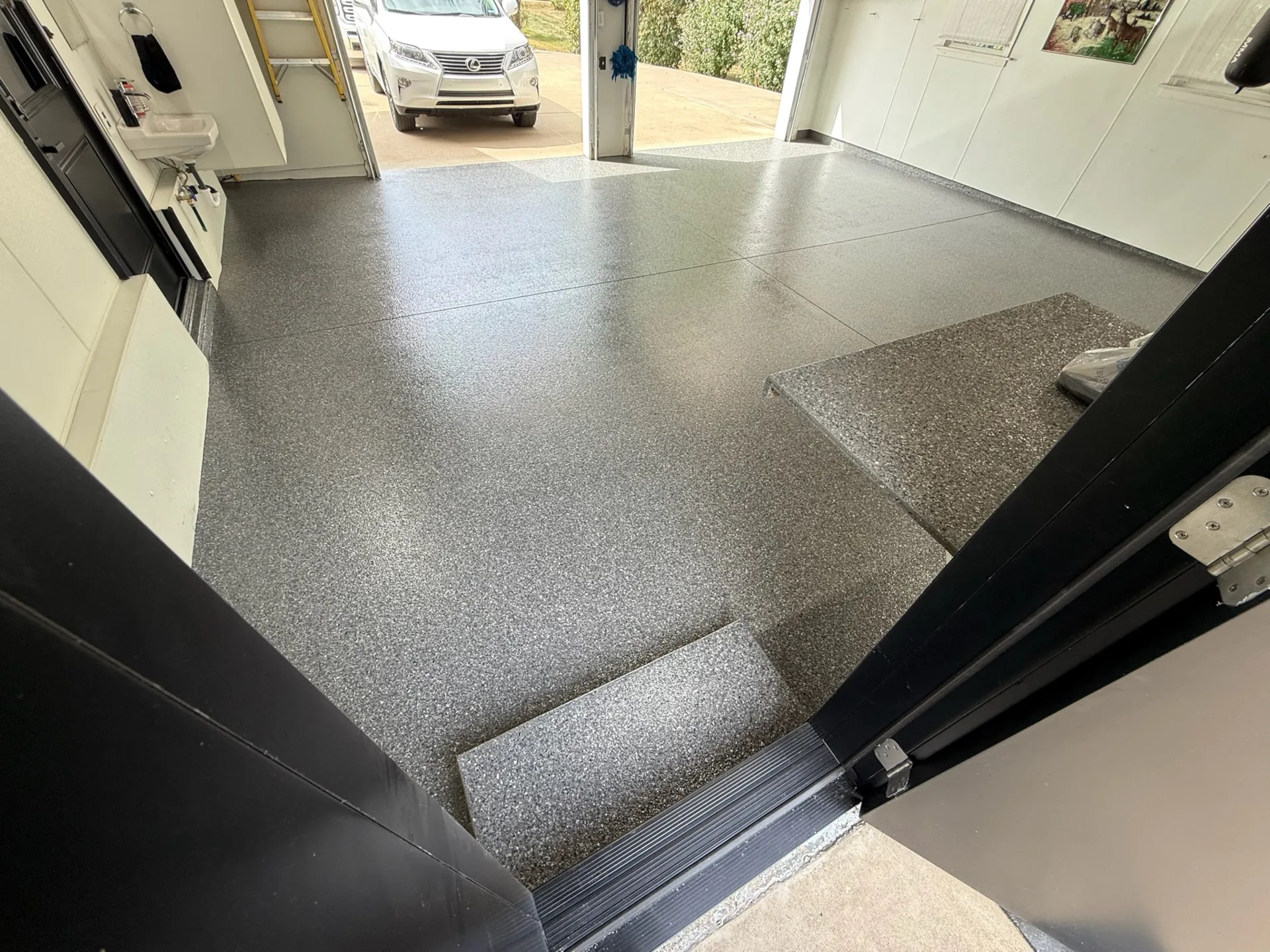
Both systems offer decorative options, but polyaspartic systems typically provide better consistency. Decorative chip blends add texture and visual depth while improving slip resistance. The result is a floor that looks intentional rather than coated as an afterthought.
Floor coating photos often tell the story clearly. Epoxy floors may start glossy but show wear patterns, yellowing, or peeling within a few years. Polyaspartic floors tend to maintain uniform color and texture far longer.
Maintenance expectations differ significantly.
Epoxy floors often require careful cleaning to avoid damage. Chips and cracks allow moisture intrusion, which accelerates failure. Repairs are noticeable and rarely seamless.
Polyaspartic floors resist staining and moisture absorption. Cleaning typically involves sweeping and occasional mopping. The non-porous surface prevents spills from soaking in, which helps the floor look newer for longer.
Lower maintenance contributes directly to longevity. A floor that resists damage requires fewer interventions.
Longevity is not just about material strength; it’s about performance under stress. Polyaspartic floor coating systems consistently outperform epoxy in garages exposed to temperature swings, sunlight, moisture, and vehicle traffic.
Epoxy floors may last in ideal conditions, but garages rarely offer those conditions. Polyaspartic systems are engineered for them.
For homeowners focused on long-term durability rather than short-term savings, polyaspartic stands out as the stronger investment.
Material alone does not guarantee success. Proper surface preparation, including mechanical grinding and concrete repair, determines how well any coating performs. Skipped prep steps lead to premature failure regardless of coating type.
Professional installation ensures:
A high-quality system installed correctly delivers results that last.
The question of polyaspartic vs epoxy ultimately comes down to expectations. Epoxy can offer a temporary upgrade. Polyaspartic delivers a long-term solution.
Homeowners looking for the best garage floor coating want durability, consistency, and minimal maintenance. Polyaspartic floors meet those demands year after year, even in harsh environments.
Choosing a coating that lasts means fewer repairs, less frustration, and a garage floor that continues to perform long after installation day. Contact us today!